Island atlas · Landscapes & species
Camiguin
2 species records name Camiguin. Explore their natural history, taxonomic history and distribution sources.
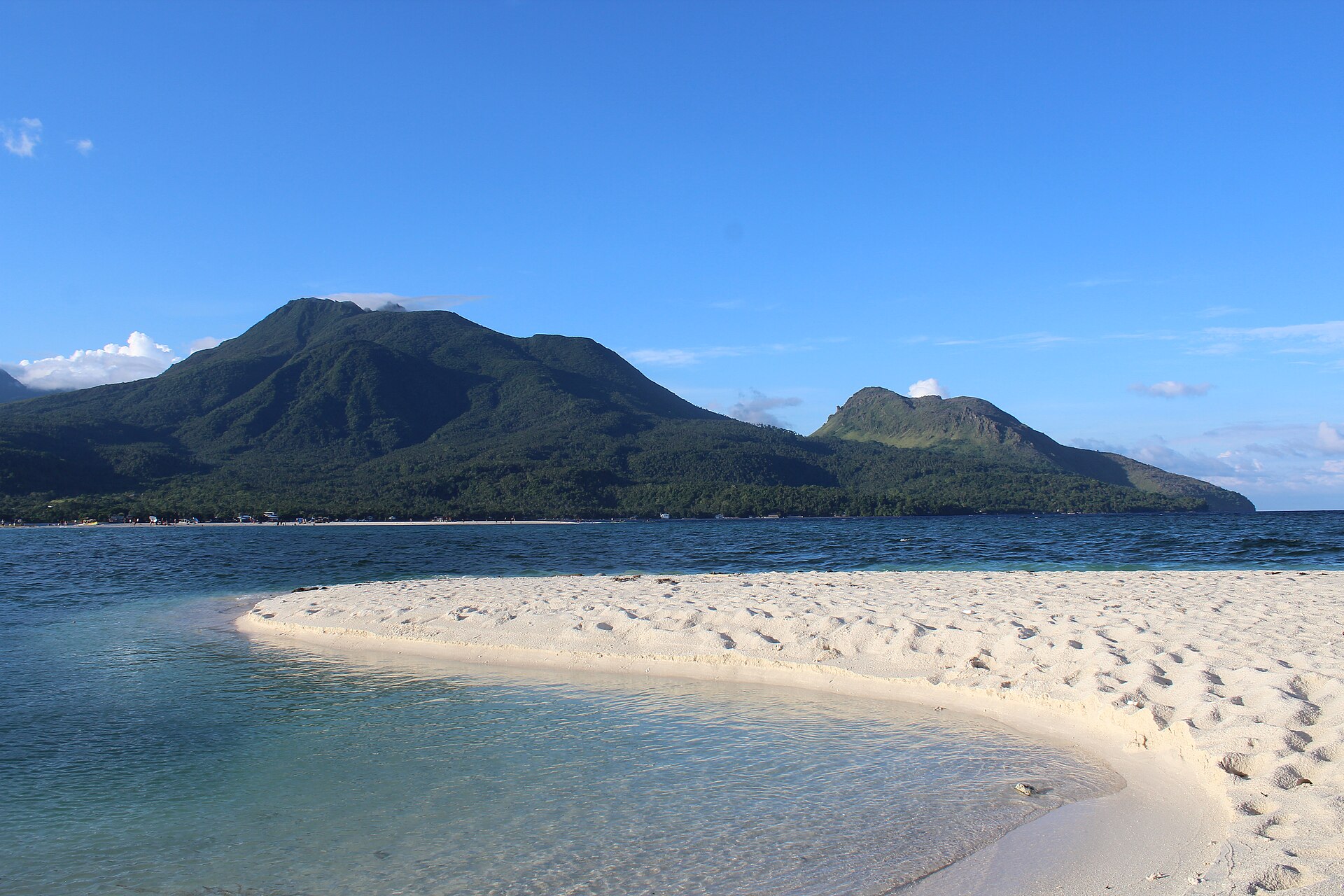
Southern Camiguin viewed from White Island. The unqualified name Camiguin in a species record does not by itself identify this island.
Photo: Wolfgang Hägele · Original photograph · CC BY-SA 4.0. Displayed to fit the frame.
Beyond the species list
A sense of place.
Two Philippine islands bear the name Camiguin: Camiguin Norte in the Babuyan Islands north of Luzon, and Camiguin Sur in the Bohol Sea north of Mindanao. This page preserves records that simply say Camiguin.
Landscape & habitats
Both namesakes have volcanic landscapes, but they occupy very different parts of the archipelago. The photograph shows the southern island; the map marks both possible locations. Separate pages describe each island more precisely.
The unqualified name remains unresolved here. A landscape photograph is not evidence for assigning a snake record to either namesake.
Geographic sources
Geographic overview checked 7 October 2026. The photograph illustrates a landscape, not a snake observation.
Islands, barriers & evolution
Zoogeography
Two namesakes, two biogeographic settings
An unqualified ‘Camiguin’ record cannot be assigned one zoogeographic history. Camiguin Norte belongs to the isolated Babuyan group north of Luzon; Camiguin Sur lies beside Mindanao and is treated as an independently isolated island in the Philippine herpetological framework.
The distinction matters when interpreting how a species reached an island or evolved there. Until an original locality can be resolved, this page retains both geographic possibilities and makes no inference about a northern or southern origin.
How to read the historical island groups
During Pleistocene glacial periods, lower sea levels exposed shallow seabeds and joined some present-day islands. Biogeographers call these reconstructed landmasses Pleistocene Aggregate Island Complexes (PAICs). Deep channels continued to separate others. This model helps explain regional similarities, but dispersal, older geology and habitat differences also shaped each fauna.
“Endemic” means restricted to a stated area; a Philippine endemic need not be confined to one island. The account above summarises published regional and local research. It does not add occurrences to the snake index below.
Regional framework: Meneses et al. (2024) ↗Zoogeographic sources · 2
- Meneses et al. (2024) · Philippine herpetology, 20 years on ↗Regional framework, Fig. 1; isolation and research gaps. Open-access review, CC0.
- Brown et al. · Phylogeny of northern Philippine Gekko ↗Author-hosted account of island-specific gecko lineages in Babuyan and Batanes.
Literature checked 7 October 2026. Survey results refer to the dates and areas studied.
Source-backed index
2 species
These are explicit source mentions, not a complete island richness estimate. Fine localities and habitat associations remain separate evidence claims.
Dendrelaphis marenae
VOGEL & VAN ROOIJEN 2008
Trimeresurus flavomaculatus
(GRAY 1842)
A source naming Camiguin does not establish occurrence in every municipality, protected area, or habitat on the island.