Adult · portrait
- Type
- Illustration
- Credit
- Mario Lutz
- Usage rights
- Authorised for display in this atlas; no third-party reuse licence granted
- Evidence status
- Illustration; not a documented specimen record or diagnostic scale reference
Elapidae · Philippine endemic
Naja philippinensisTaylor, 1922
Length: Adults average about 1 m in the published species introduction. The secondary species account gives 1.6 m as an upper length. These figures are not a newly measured sample or an absolute biological limit.
Tan et al. (2019), Introduction; Wikipedia, Description
Venom: Neuromuscular paralysis can threaten breathing. Short alpha-neurotoxins are a major component of the studied venom.
Abstract; proteomic and neurotoxicity findings
Venom effects and medical significance are different from toxicity rankings. Do not handle a snake on the basis of this summary.
A Philippine endemic with a familiar hood and medically important venom. Its documented island distribution includes Luzon and Mindoro, extending to Marinduque, Masbate, Catanduanes and Lubang. Explore its appearance, natural history and the evidence behind each place below.
Research example · 6 September 2026 · Expert review pending
Explore the island records ↓The illustrated collection
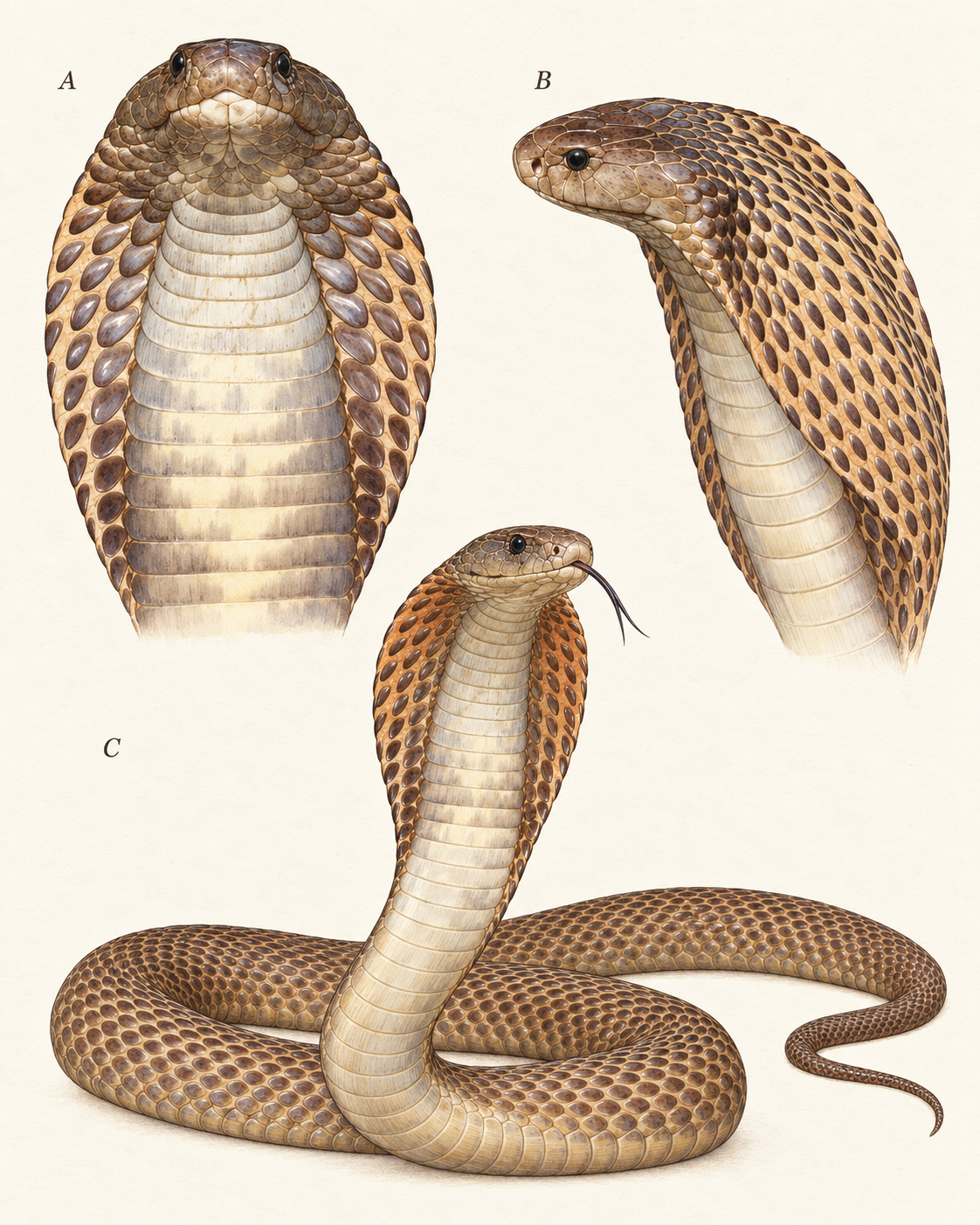
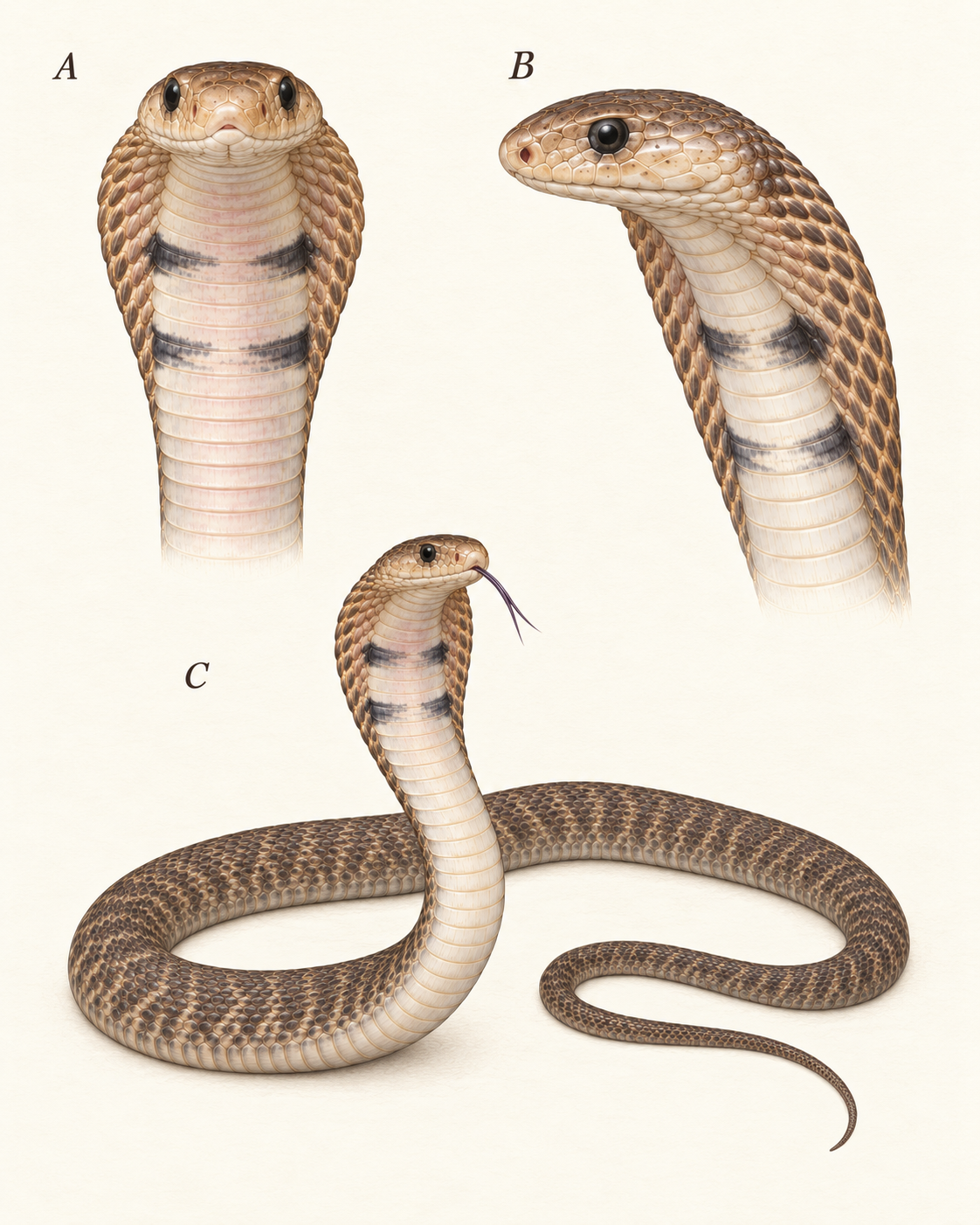
These contributor-labelled adult and juvenile studies show artistic interpretations, not documented specimens or a diagnostic scale reference. Colour and proportions vary; size is not to scale. Individual credits and usage rights are listed below.
Media provenance
A closer look
IDENTIFICATION
Usually light brown to olive-brown above, with a hood that expands during a defensive display. Colour is variable: two dark-grey adults were documented in Isabela. That report used an absent loreal scale, one preocular, three postoculars and 21 midbody scale rows to support identification. These are characters from the reported specimens, not a reason to approach a living cobra.
supported · ai researched
Melanism in Northern Philippine Cobra from Isabela Province ↗
pp. 56–57: observation, identification and distribution remarks
HABITAT
Luzon surveys associate encounters with agricultural areas around settlements. Brown and colleagues documented a Cagayan specimen and discussed records from the Sierra Madre; they explicitly noted uncertainty about the circumstances of its capture. Such records establish use of modified landscapes, but do not mean the species occupies every farm or forest patch.
supported · ai researched
The amphibians and reptiles of Luzon Island, Philippines, VIII ↗
p. 88: Naja philippinensis species account
DIET
A secondary Philippine natural-history account describes small rodents and frogs as principal prey, with occasional snakes, lizards and birds. Treat this as a qualitative account: this profile has no verified field dataset giving prey proportions, seasonal changes or differences between adults and juveniles.
provisional · ai researched
Phl cobra, 12 other reptiles on endangered list ↗
Species description and diet paragraphs; secondary natural-history summary
REPRODUCTION
The species is oviparous: females lay eggs. A source-verified clutch-size range, incubation period and seasonal breeding calendar are not yet established in this profile. Those details should be added from a species-specific study or an attributed breeding record, with captive and wild observations identified separately.
supported · ai researched
Naja philippinensis — The Reptile Database ↗
Taxonomy, distribution, reproduction and type records; accessed 6 September 2026
BEHAVIOUR
This is a spitting cobra. Sy and Taggueg recorded two adults sheltering beneath sacks on agricultural land at 49 m elevation. Their record illustrates both shelter use and colour variation; its midday discovery is not evidence of an exclusively daytime activity pattern.
supported · ai researched
Melanism in Northern Philippine Cobra from Isabela Province ↗
pp. 56–57: observation, identification and distribution remarks
VENOM
Envenoming can cause rapidly developing neuromuscular paralysis and threaten breathing. The 2019 proteomic study identified short alpha-neurotoxins as the main neurotoxic component of the sampled venom. The paper describes the species as WHO Category 1 medically important. Laboratory venom results should not be converted into a “deadliest snake” ranking or a prediction of an individual bite outcome.
supported · ai researched
Proteomic insights into short neurotoxin-driven, highly neurotoxic venom of Philippine cobra ↗
Abstract: venom composition and neuromuscular paralysis
Snakebite Management & Treatment in the Philippines: Handbook for Medical Practitioners ↗
ISBN 9781300743125; publisher description verified. Further reading; book text not reviewed for this profile.
CONSERVATION
The 2018 Philippine synopsis reports Near Threatened, citing the IUCN 2016 listing. This is the dated status available to this profile, not a newly verified 2026 assessment. Direct confirmation of the current Red List assessment remains pending.
supported · ai researched
Synopsis of the Snakes of the Philippines ↗
p. 456: Naja philippinensis; Map 26C
CONSERVATION
Persecution and exploitation are identified as potential threats in the Luzon field survey. The presence of cobras near people makes clear identification, encounter avoidance and informed local response especially relevant. The survey does not provide a national population estimate or a measured island-by-island trend.
supported · ai researched
The amphibians and reptiles of Luzon Island, Philippines, VIII ↗
p. 88: Naja philippinensis species account
TAXONOMY
Naja philippinensis is treated as a distinct species endemic to the Philippines. Older literature used Naja naja philippinensis. The 2018 synopsis names Luzon, Mindoro, Marinduque and Masbate. The later field note also lists Catanduanes and Lubang, referring to 2017 distribution records.
supported · ai researched
Synopsis of the Snakes of the Philippines ↗
p. 456: Naja philippinensis; Map 26C
RESEARCH LIMITATIONS
The current Reptile Database gives Pangasinan Province, Luzon, as the type locality, whereas the 2018 synopsis gives Manila, Luzon. Both report loss of the original holotype. The discrepancy is retained explicitly until the original description and subsequent type actions are reconciled.
supported · ai researched
Naja philippinensis — The Reptile Database ↗
Taxonomy, distribution, reproduction and type records; accessed 6 September 2026
Across the archipelago
Choose an island to read its evidence. The map shows documented areas; it does not imply continuous occupation of an island.
Documented islands: gold · island groups: dashed circles
Island-level records · not continuous habitat coverage. Dashed circles locate groups, not individual observations.
Philippine distribution
Endemic to the Philippines.
Philippines (Luzon, Mindoro, Masbate, Marinduque, Catanduanes, Lubang) Type locality: Pangasinan Province, Luzon, Philippines.
References attached to this species account. Island-specific evidence is shown separately where available.
The Reptile Database — species checklist, 17 June 2026 ↗
Philippine cobra — Description ↗
Synopsis of the Snakes of the Philippines ↗
Melanism in Northern Philippine Cobra from Isabela Province ↗
Proteomic insights into short neurotoxin-driven, highly neurotoxic venom of Philippine cobra ↗
The amphibians and reptiles of Luzon Island, Philippines, VIII ↗
Naja philippinensis — The Reptile Database ↗
Snakebite envenoming: treatment and first aid ↗
Phl cobra, 12 other reptiles on endangered list ↗
Die Kobras des philippinischen Archipels, Teil I: Die Philippinen-Kobra ↗
Snakebite Management & Treatment in the Philippines: Handbook for Medical Practitioners ↗
Living with venomous wildlife
Observe from a distance. Do not attempt to handle, corner or capture a cobra.
After a suspected bite, keep the person still, immobilise the affected limb and arrange immediate transport to medical care. Do not apply a tight tourniquet or use unproven remedies. Do not wait for symptoms to become severe.
WHO guidance on snakebite first aid ↗Species record
Range noteCountry/island text is not a range polygon or locality record.
Philippines (Luzon, Mindoro, Masbate, Marinduque, Catanduanes, Lubang) Type locality: Pangasinan Province, Luzon, Philippines.
Names through time
Naja tripudians var. caeca BOULENGER 1896 (part.) Naja naja philippinensis TAYLOR 1922: 265 Naja kaouthia samarensis DERANIYAGALA 1960 (part) Naja sputatrix samarensis DERANIYAGALA 1961 (part) Naja naja philippinensis — HARDING & WELCH 1980 Naja philippinensis — WÜSTER & THORPE 1990 Naja philippinensis — WELCH 1994: 93 Naja (Naja) philippinensis — WALLACH et al. 2009 Naja philippinensis — WALLACH et al. 2014: 462
Venomous! Distribution: For a map see Shi et al. 2022: 3 (Fig. 1).
Uetz, P.; Freed, P.; Aguilar, R.; Reyes, F.; Kudera, J.; Hošek, J. (eds.)
Leviton, A. E.; Siler, C. D.; Weinell, J. L.; Brown, R. M.
Proceedings of the California Academy of Sciences 64(14): 399–568
Wikipedia contributors
Secondary length account: 1 m average and 1.6 m reported upper length, attributed there to the University of Adelaide Clinical Toxinology Resource. The 1 m adult average is also stated in Tan et al. (2019). Wikipedia is not treated as a measured-specimen dataset.
Leviton, A. E.; Siler, C. D.; Weinell, J. L.; Brown, R. M.
p. 456: Naja philippinensis; Map 26C
Sy, E. Y.; Taggueg, J. B.
pp. 56–57: observation, identification and distribution remarks
Tan, C. H.; Wong, K. Y.; Chong, H. P.; Tan, N. H.; Tan, K. Y.
Abstract: venom composition and neuromuscular paralysis
Brown, R. M. et al.
p. 88: Naja philippinensis species account
Uetz, P. et al. (editors)
Taxonomy, distribution, reproduction and type records; accessed 6 September 2026
World Health Organization
First aid for snakebites; accessed 6 September 2026
Philstar.com
Species description and diet paragraphs; secondary natural-history summary
Lutz, M.
SAURIA 28(3), pp. 5–11; publisher catalogue verified, full article not consulted
Mario Lutz
ISBN 9781300743125; publisher description verified. Further reading; book text not reviewed for this profile.
Follow the evidence
Taxonomic synthesis · 2018
Leviton, A. E.; Siler, C. D.; Weinell, J. L.; Brown, R. M.
p. 456: Naja philippinensis; Map 26C
Field observation · 2018
Sy, E. Y.; Taggueg, J. B.
pp. 56–57: observation, identification and distribution remarks
Primary venom research · 2019
Tan, C. H.; Wong, K. Y.; Chong, H. P.; Tan, N. H.; Tan, K. Y.
Abstract: venom composition and neuromuscular paralysis
Field survey · 2013
Brown, R. M. et al.
p. 88: Naja philippinensis species account
Taxonomic database · 2026
Uetz, P. et al. (editors)
Taxonomy, distribution, reproduction and type records; accessed 6 September 2026
Medical guidance · accessed 2026
World Health Organization
First aid for snakebites; accessed 6 September 2026
Secondary reporting · 2012
Philstar.com
Species description and diet paragraphs; secondary natural-history summary
Further reading · 2006
Lutz, M.
SAURIA 28(3), pp. 5–11; publisher catalogue verified, full article not consulted
Medical handbook · 2024
Mario Lutz
ISBN 9781300743125; publisher description verified. Further reading; book text not reviewed for this profile.