Island atlas · Landscapes & species
Negros
31 species records name Negros. Explore their natural history, taxonomic history and distribution sources.
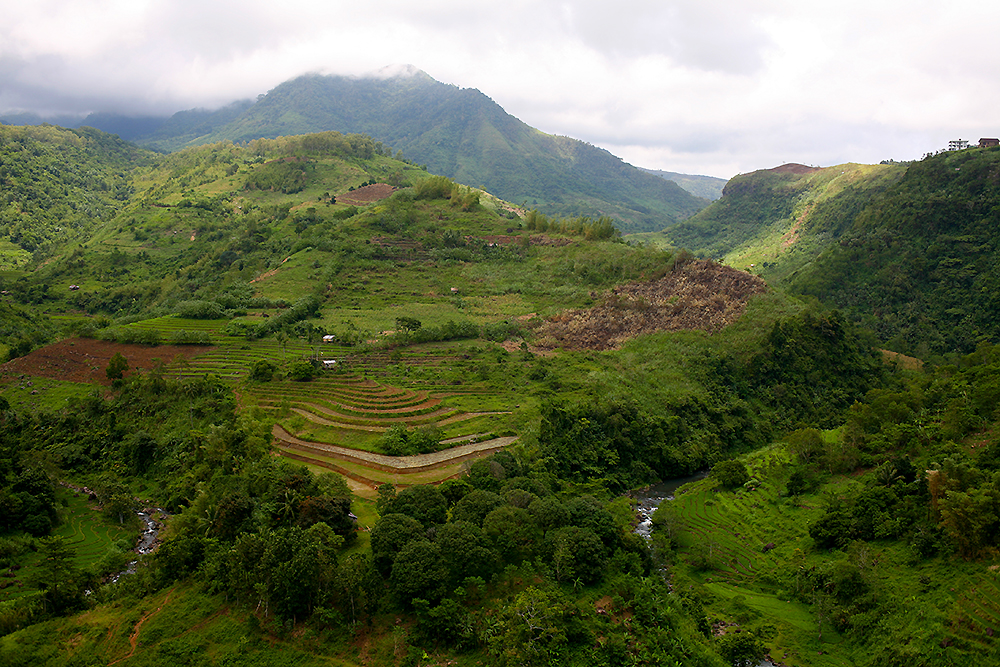
Kanlaon Volcano on Negros, seen from Don Salvador Benedicto.
Photo: Paolobon140 · Original photograph · Public domain. Displayed to fit the frame.
Beyond the species list
A sense of place.
Negros is one of the large islands of the Visayas. Its island identity spans the two provinces of Negros Occidental and Negros Oriental; administrative boundaries do not divide it into separate landmasses.
Landscape & habitats
Kanlaon Volcano is a prominent feature of the island’s mountain scenery. Seen from Don Salvador Benedicto in the photograph, its broad volcanic form rises beyond the surrounding landscape. The slopes and uplands provide geographic context distinct from the coastal parts of Negros.
Geographic sources
Geographic overview checked 7 October 2026. The photograph illustrates a landscape, not a snake observation.
Islands, barriers & evolution
Zoogeography
Shared Visayan history, distinct modern assemblages
Negros shares the West Visayan historical island complex with Panay and other central islands. Comparative work on Panay’s amphibians and reptiles found the expected strong affinities with Negros, consistent with their historical connections.
Similarity is not identity. Differences between island inventories can reflect local evolution, habitats, losses and research effort. The regional connection is most useful as a question to investigate—why are particular lineages shared while others have narrower ranges?—rather than as permission to merge island checklists.
How to read the historical island groups
During Pleistocene glacial periods, lower sea levels exposed shallow seabeds and joined some present-day islands. Biogeographers call these reconstructed landmasses Pleistocene Aggregate Island Complexes (PAICs). Deep channels continued to separate others. This model helps explain regional similarities, but dispersal, older geology and habitat differences also shaped each fauna.
“Endemic” means restricted to a stated area; a Philippine endemic need not be confined to one island. The account above summarises published regional and local research. It does not add occurrences to the snake index below.
Regional framework: Meneses et al. (2024) ↗Zoogeographic sources · 2
- Ferner et al. (2000) · The amphibians and reptiles of Panay Island ↗Authors’ full text; comparison with Negros and Cebu, and limits of early inventories.
- Meneses et al. (2024) · Philippine herpetology, 20 years on ↗Regional framework, Fig. 1; isolation and research gaps. Open-access review, CC0.
Literature checked 7 October 2026. Survey results refer to the dates and areas studied.
Source-backed index
31 species
These are explicit source mentions, not a complete island richness estimate. Fine localities and habitat associations remain separate evidence claims.
Boiga angulata
(PETERS 1861)
Calamaria gervaisii
DUMÉRIL, BIBRON & DUMÉRIL 1854
Calamaria lumbricoidea
BOIE 1827
Cerberus schneiderii
(SCHLEGEL 1837)
Chrysopelea paradisi
BOIE 1827
Coelognathus erythrurus
(DUMÉRIL, BIBRON & DUMÉRIL 1854)
Cyclocorus lineatus
(REINHARDT 1843)
Dendrelaphis fuliginosus
GRIFFIN 1909
Dendrelaphis marenae
VOGEL & VAN ROOIJEN 2008
Gerrhopilus hedraeus
(SAVAGE 1950)
Gonyosoma oxycephalum
(BOIE 1827)
Hemibungarus calligaster
(WIEGMANN 1835)
Hemibungarus gemianulis
PETERS 1872
Laticauda semifasciata
(REINWARDT 1837)
Lycodon capucinus
BOIE 1827
Malayopython reticulatus
(SCHNEIDER 1801)
Malayotyphlops canlaonensis
(TAYLOR 1917)
Malayotyphlops castanotus
(WYNN & LEVITON 1993)
Malayotyphlops luzonensis
(TAYLOR 1919)
Oligodon modestus
GÜNTHER 1864
Oxyrhabdium leporinum
(GÜNTHER 1858)
Oxyrhabdium modestum
(DUMÉRIL 1853)
Psammodynastes pulverulentus
(BOIE 1827)
Pseudorabdion mcnamarae
(TAYLOR 1917)
Pseudorabdion montanum
LEVITON & BROWN 1959
Pseudorabdion oxycephalum
(GÜNTHER 1858)
Ptyas luzonensis
(GÜNTHER 1873)
Ramphotyphlops cumingii
(GRAY 1845)
Trimeresurus flavomaculatus
(GRAY 1842)
Tropidolaemus subannulatus
(GRAY 1842)
Tropidonophis negrosensis
(TAYLOR 1917)
A source naming Negros does not establish occurrence in every municipality, protected area, or habitat on the island.